
Project "INVestigAting non-indigenous Species in hotspot areas of the IONian Sea" (INVASIONS) targets ports and marinas as non-indigenous species (NIS) hotspots, combining field surveys, innovative collectors and molecular tools. It integrates existing and new data to support risk assessment, management decisions and transferable, cost-efficient, FAIR-compliant monitoring guidelines
Objectives and Challenges
The INVASIONS project aims to establish a standardised and comprehensive framework for monitoring and reporting NIS in ports of the Ionian Sea, which could be replicated elsewhere. This comprehensive framework will be implemented in both the major commercial ports and marinas, where the current efforts to detect NIS remain fragmented and non-uniform across southern European regions.
Launched in June 2026, the official bilingual INVASIONS website provides a central point of access to information about the project, its scientific background, objectives, research team, activities and latest news, while preparing the ground for the publication of future results and resources.
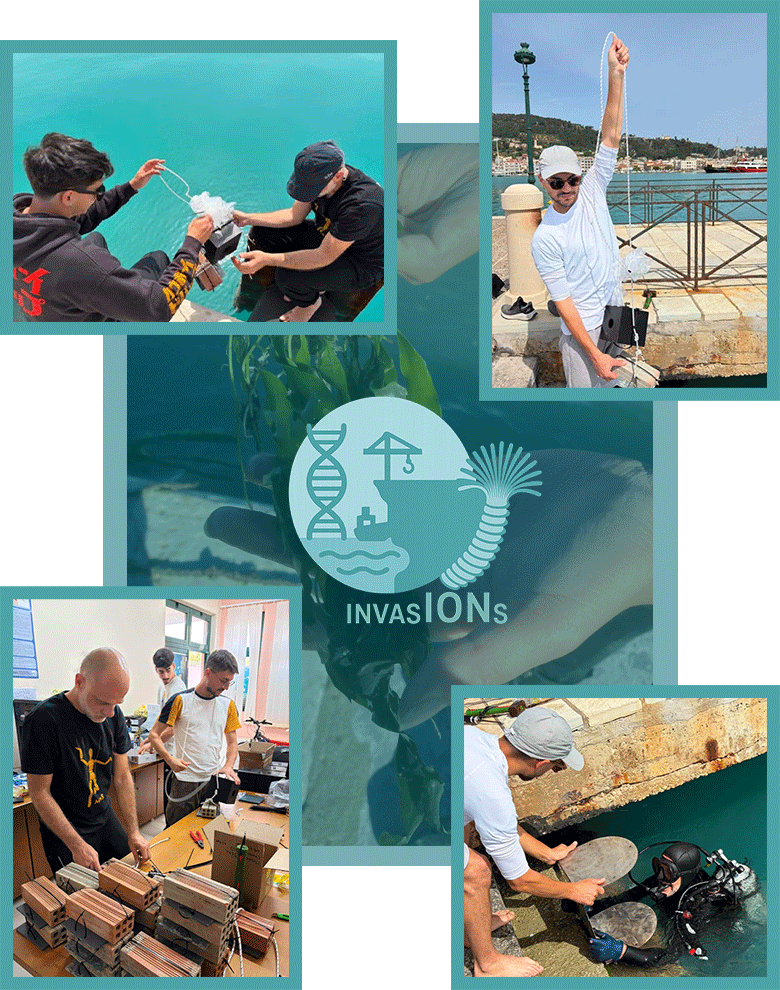
In May 2026, the INVASIONS team deployed 24 Non-Indigenous Species (NIS) collector units together with instruments recording key abiotic parameters in four ports representing the main biogeographic subregions of the Greek Ionian Sea.
From 4 to 24 April 2026, the INVASIONS team carried out an extensive field campaign across 16 ports and marinas of the Greek Ionian Sea.